Viking Range Repair
Why Viking Igniters Misbehave in Damp Foothill Kitchens
Damp is the commonest local reason a Viking burner ticks without lighting in Issaquah. How moisture reaches the spark, which kitchens suffer most, what an owner can safely do about it, and when the fault is a worn part instead.
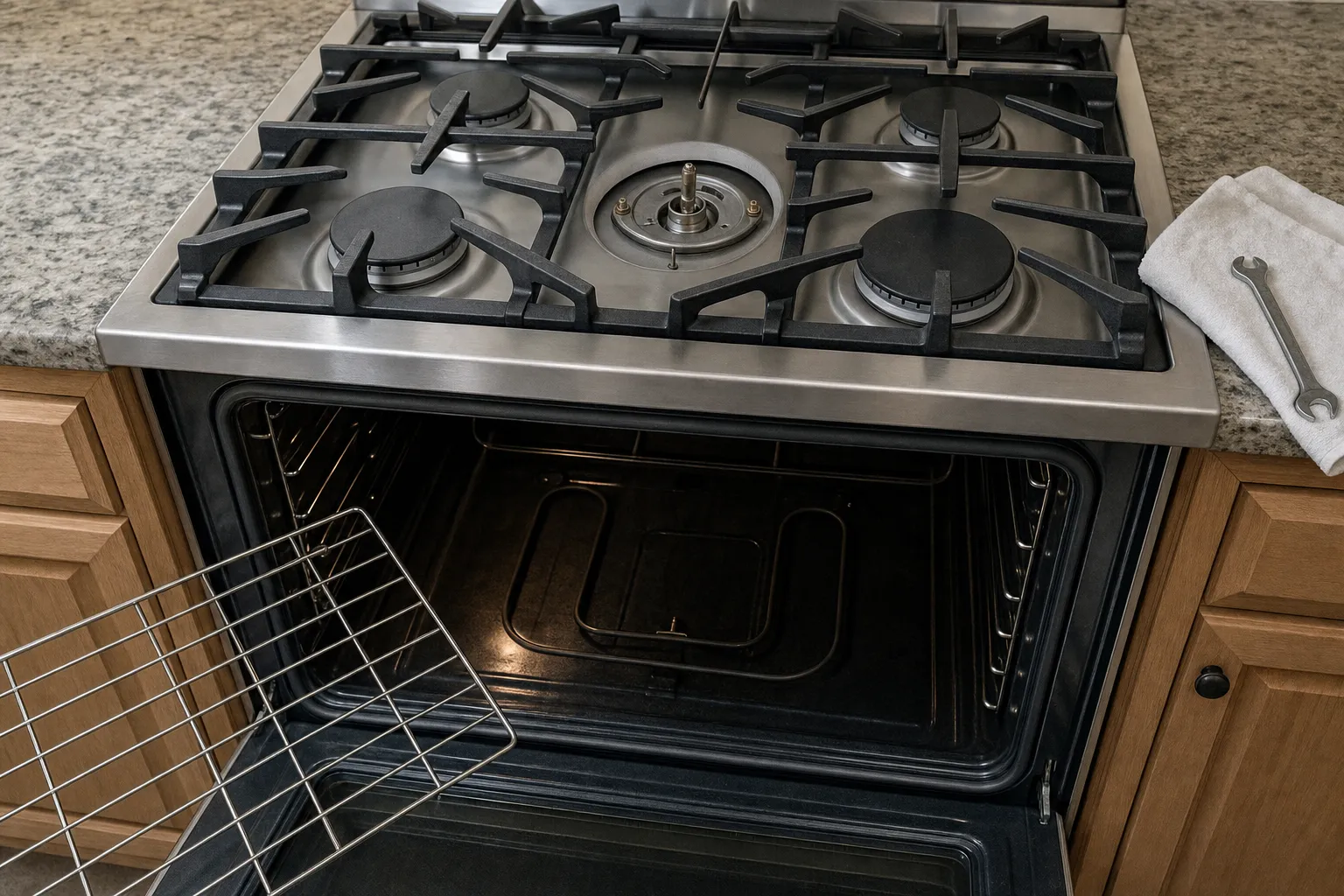
Issaquah sits among forested foothills, and for much of the year the air in its kitchens is damp. For a Viking gas range that matters in one place above all others: the ignition. The spark that lights a burner is a small, high-voltage event, and it needs a clean, dry path to do its job. Moisture offers it a shortcut, and a burner that ticks without lighting is often the result, with no worn part anywhere on the range.
This note explains how damp reaches the spark, which kitchens in town see it most, what an owner can safely do about it, and how to tell a damp problem from a part that has genuinely failed.
How damp reaches the spark
Each sealed burner has an electrode: a metal tip held in a white ceramic insulator, set close to the burner so that a spark jumps the small gap to the metal just where gas leaves the ports. The ceramic’s job is to keep the high voltage on the tip until it jumps that gap.
A film of water on the ceramic, or water standing in the well around it, gives the voltage an easier route to the burner body. The spark then jumps early, jumps weakly, or leaks away without a visible snap at all. You still hear ticking, because the module is still firing; the gas simply never meets a spark strong enough to light it.
Two other things make damp worse. Cooking residue and soot on the ceramic hold moisture against it, so a dirty electrode is far more sensitive to damp than a clean one. And the switches behind the knobs, which tell the module when to fire, can be fooled by liquid that has run down past a knob. That is when the whole cooktop ticks with every knob turned off.
Where Issaquah kitchens make it worse
Some kitchens here hold damp much longer than others. Houses under heavy tree cover on the Squak Mountain and Cougar Mountain slopes see little direct sun, and a kitchen that stays cool overnight lets moisture settle on every cold metal surface, the cooktop included. Homes left empty and unheated for a stretch of the winter come back with the same symptom, often on several burners at once.
Cooking habits add to it. A tall pot boiled with the hood off sends steam straight up and back down onto the cooktop. A wipe-down with a soaked cloth, or cleaner sprayed across the burners, leaves liquid in exactly the wells where the electrodes sit.
The telling pattern is timing. A burner that refuses to light first thing in the morning and lights normally by the afternoon is almost always drying out through the day. A worn part does not keep office hours.
What an owner can safely do
Everything below is done with every knob off and the cooktop cold.
- Clean dry, not wet. Wring the cloth out until it is barely damp, and never spray cleaner at the burners or the knob panel. Spray the cloth instead.
- Dry the wells after a spill. Lift the cap and the burner head, soak up standing liquid with a paper towel or a cotton bud, and leave the parts off for an hour or two to air.
- Keep the ceramic clean. A light wipe removes the film that holds damp; anything harder than a soft brush can chip it.
- Use the hood. Run it whenever something boils, winter included, so the steam leaves the kitchen instead of settling back.
- Give a cold kitchen time. After a spell with the house shut up, warm the room before expecting every burner to light first time.
If a burner still will not light once it is clean, dry and correctly seated, stop there. The fault is no longer the damp.
When it is not the damp
Damp causes a burner to fail and then recover. A part that has failed stays failed. The spark electrode is the first suspect when one burner will not light on a dry afternoon, and its insulator is the usual reason: a hairline crack or a dark carbon track down the ceramic insulator gives the spark a permanent shortcut that no amount of drying cures.
The harder case is the range whose igniters fail again and again, a new electrode lasting one wet season before the ticking returns. At that point the choice is between treating the kitchen and replacing parts on a schedule, and igniters that keep failing in a damp kitchen sets that choice out with the figures beside it.
Viking Repair Issaquah checks a damp-kitchen ignition fault the same way every time: the burner dried and seated, the spark compared with the healthy burners beside it, and the electrode, its insulator and the switch behind the knob tested in turn. Ring (425) 920-9484 with the model number from the range’s label, and mention whether the fault comes and goes with the weather.
Asked about this
My Viking cooktop clicks non-stop after I cleaned it. Is it broken?
Usually not. Liquid that ran down past the knobs or into an electrode well can keep the ignition sparking until it dries. Turn every knob off, lift the caps, let the cooktop dry for a few hours and try again. If the clicking carries on once it is dry, call Viking Repair Issaquah on (425) 920-9484.
Is a burner that ticks without lighting dangerous?
The ticking is not; unburned gas is. If a burner will not catch within a few seconds, turn it off and let the gas clear before trying again. If you smell gas with every knob off, leave the range alone, get outside and call the gas utility or 911, then Viking Repair Issaquah on (425) 920-9484.
Should I run the hood while I cook even in winter?
Yes, while anything is boiling or simmering. The hood carries steam out before it settles on the cooktop, which keeps moisture away from the electrode wells and the switches behind the knobs. It costs little and saves a damp start the next morning. Viking Repair Issaquah, (425) 920-9484, handles the ignition when drying is not enough.