Viking Range Repair
Viking Range Burner Clicks But Will Not Light
A clicking Viking burner is almost never a dead cooktop. Here is what the click actually is, the four things that stop the flame catching, and which of them you can clear yourself in an Issaquah kitchen.
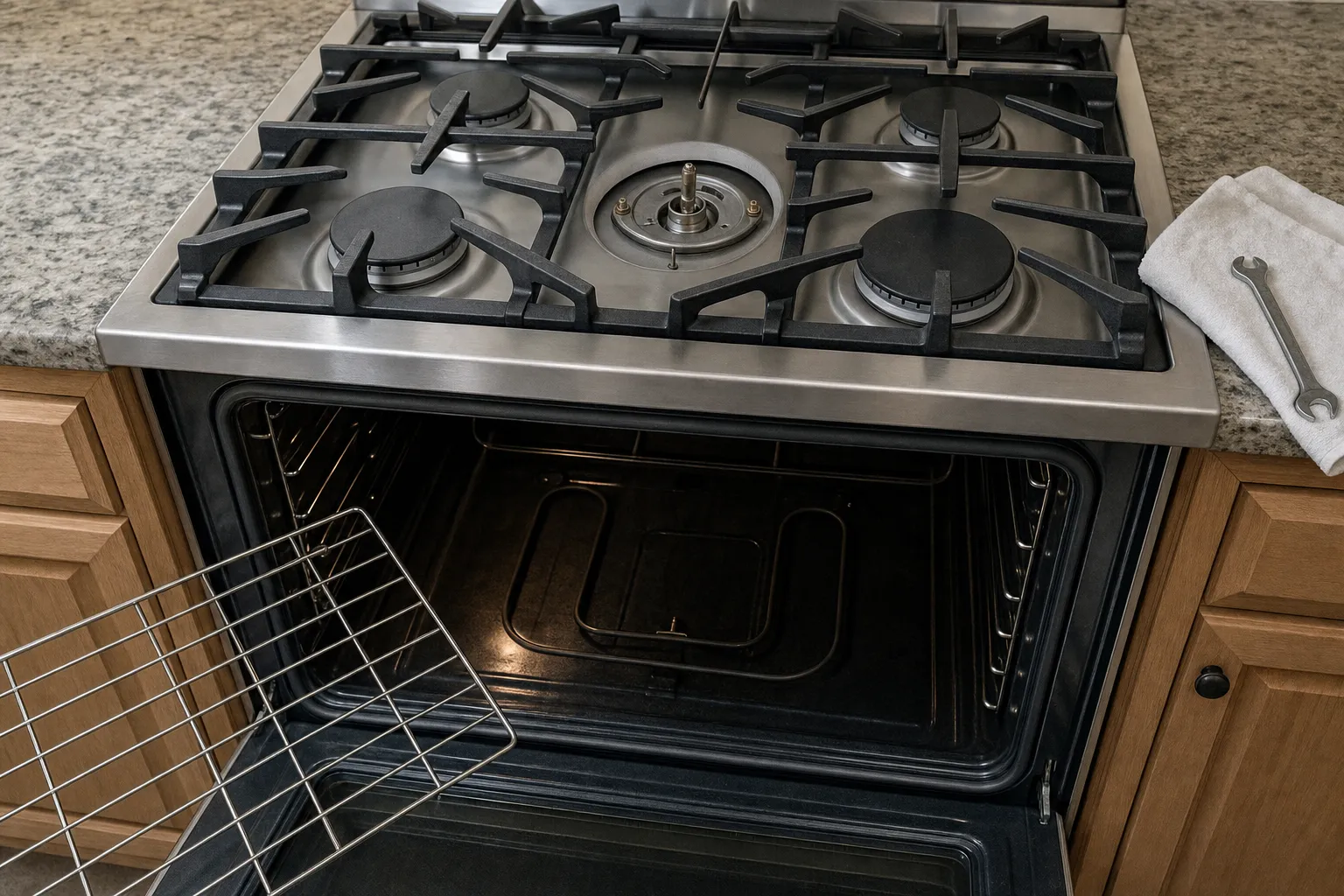
Everyone describes it the same way on the phone: “the front left just clicks and clicks.” On a Viking sealed-burner cooktop that sentence narrows the problem down fast, because the clicking itself is proof that a lot of the system is working. Power is reaching the spark module. The switch under the knob is closing. The module is firing. What is missing is the last inch — a spark that lands where the gas is, or gas arriving where the spark is.
Below is the order a technician works through it, and where the line is between what you can reasonably clear yourself in ten minutes and what needs a meter.
What the click actually is
The click is a high-voltage spark jumping the gap between an electrode and the burner. The spark module makes that voltage, and on many cooktops one module serves several electrodes, which is why turning a single knob can set every burner ticking at once.
If yours does that, it is the design, not a second fault. You are hearing healthy electrodes firing alongside the one burner that will not catch.
It also means “the whole cooktop clicks constantly, even with every knob off” is a genuinely different fault — usually moisture bridging a switch or a failed module stuck on — and one worth calling about rather than living with, because a module firing continuously will eventually burn out.
Four reasons the flame never forms
Roughly from the commonest to the rarest:
- A burner cap sitting proud on one edge, or turned slightly out of true. Flat and square on the base is the only position that works. Lift it, look at the underside, look at the ring of ports. If it rocks, if there is a build-up of carbon on the seat, or if it went back on rotated after a clean, the flame ring cannot form and the spark has nothing to ignite.
- Blocked ports. Boil-over from a stock pot dries into the port ring and closes it off. The ports nearest the electrode matter most — if those three or four are blocked, the spark is firing into clean air.
- A wet or cracked spark electrode. After a spill or an enthusiastic clean, water sits in the electrode well and shorts the spark to the burner body. You will often hear the click change character — sharper, or coming from the wrong place. A hairline crack in the white ceramic insulator does the same thing permanently.
- A failing spark module, or the switch behind the knob and its harness. This is the one that needs a meter. Modules degrade rather than die outright: one channel weakens, that burner takes longer and longer to catch, then stops.
Note what is not on that list — the gas valve, the regulator, the orifice. Those produce different symptoms (no gas smell at all, or a lazy yellow flame on every burner), and replacing them for a clicking fault is a common way to spend money without fixing anything.
What to check before you call
Range off, knobs off. This takes about ten minutes.
- Lift the cap and the burner head off. They come off by hand on a cold cooktop. Look at the port ring for anything crusted into it.
- Clear the ports with a straightened paperclip or a sewing needle. Not a drill bit, not a toothpick — a toothpick snaps off inside the port and makes the situation worse.
- Dry the electrode well. A cotton bud, then leave it uncovered for an hour if there has been a spill. A surprising number of “dead” burners come back after they have simply dried out.
- Inspect the ceramic. Any crack, chip, or dark carbon track running down the insulator means the electrode is shorting and needs replacing.
- Reseat everything squarely. Cap flat, head located on its pins, nothing rocking.
Then try it. If the burner lights, you were the whole repair. If it clicks with a clean, dry, correctly seated burner, the fault is electrical and you have just saved the technician twenty minutes of ruling things out.
When the spark module is genuinely the answer
A module is confirmed, not guessed. The test is comparative: the working burners tell you what a healthy spark on that cooktop looks and sounds like, and the suspect channel is measured against them. A weak channel produces a visibly shorter, orange-tinged spark rather than the crisp blue-white snap of a good one.
The pattern that points hardest at the module is a burner that used to light on the third or fourth click, then the sixth, then not at all — a slow decline over weeks rather than a sudden failure. Electrodes tend to fail abruptly; modules fade.
Replacing one means reaching the module inside the range, unplugging its harness and fitting the module listed for that model. The wrong module for the burner layout is the classic mistake in home attempts at this repair, and the result is a cooktop where two burners now fail to spark instead of one.
What this costs and when it is worth it
Two things set the price of an ignition repair, and both are knowable before anyone opens a wallet. The first is which part it is: an electrode is a fraction of a spark-module replacement, and it is also the more common failure — the cheaper outcome is the likelier one. The second is access, which on a cooktop is modest; nobody is pulling the gas train apart to change an electrode.
Either way it is a parts-and-labour job on a small component, set against the price of a new range. That comparison is what makes the decision straightforward. You get the actual figure on the day, in writing, before anything comes apart — and the $89 visit comes off it in full if you go ahead.
The repair stops being worth it in one specific case: when the burner bodies themselves are corroded through, which happens on ranges that have lived under a leaking hood or through a flood. At that point you are replacing burner assemblies rather than ignition parts, and the numbers change. You hear that on the day rather than after parts have been ordered.
Getting the model number right
Every quote depends on it. Viking fixes a model and serial label to the range itself, and the use-and-care guide for your range shows where it sits; read it with the range cold. The model number tells the technician the width, the burner layout and the fuel, and from those the module, the electrode and how the cooktop comes apart.
Two minutes finding it before you dial saves a return visit for the right part, which is the only part of this repair that ever really costs anyone time.
Asked about this
Can I still cook on the other burners while one of them only clicks?
Yes, as long as the clicking burner's knob is turned off and there is no smell of gas in the kitchen. If you do smell gas at any point, turn every knob off, leave the range alone, get people out and call the gas utility or 911 from outside before calling Viking Repair Issaquah on (425) 920-9484.
Why does every burner tick when only one of them is at fault?
If every electrode on your cooktop ticks when you turn a single knob, the ignition is wired to spark them together, and the ticking itself is not a fault. The fault is the one burner that does not catch. Viking Repair Issaquah checks that burner's cap, ports and electrode first; ring (425) 920-9484 if clearing them does not bring the flame back.
The burner lights but will not stay lit at a low setting. Is that the same problem?
No. A flame that lights and then fades or blows out at low is a different fault from one that never catches: the usual suspects are the burner ports, the cap seating and the valve's low setting, not the spark. Viking Repair Issaquah looks at those separately; call (425) 920-9484 and say which of the two you are seeing.
What does an ignition repair on a Viking range cost in Issaquah?
Ignition work sits inside the igniter-or-burner-assembly band printed on the range repair page, and an electrode lands at the low end of it more often than a spark module does. Viking Repair Issaquah puts the exact figure in writing before anything is opened, and the $89 visit comes off it if you go ahead. Call (425) 920-9484.