Viking Range Repair
Issaquah Water, Scale and Cleaning a Viking Cooktop
Two tap waters leave two different residues on a Viking cooktop in Issaquah. How to clean burners, caps and brass without damaging ports or electrodes, and why a steam cleaner does more harm than good.
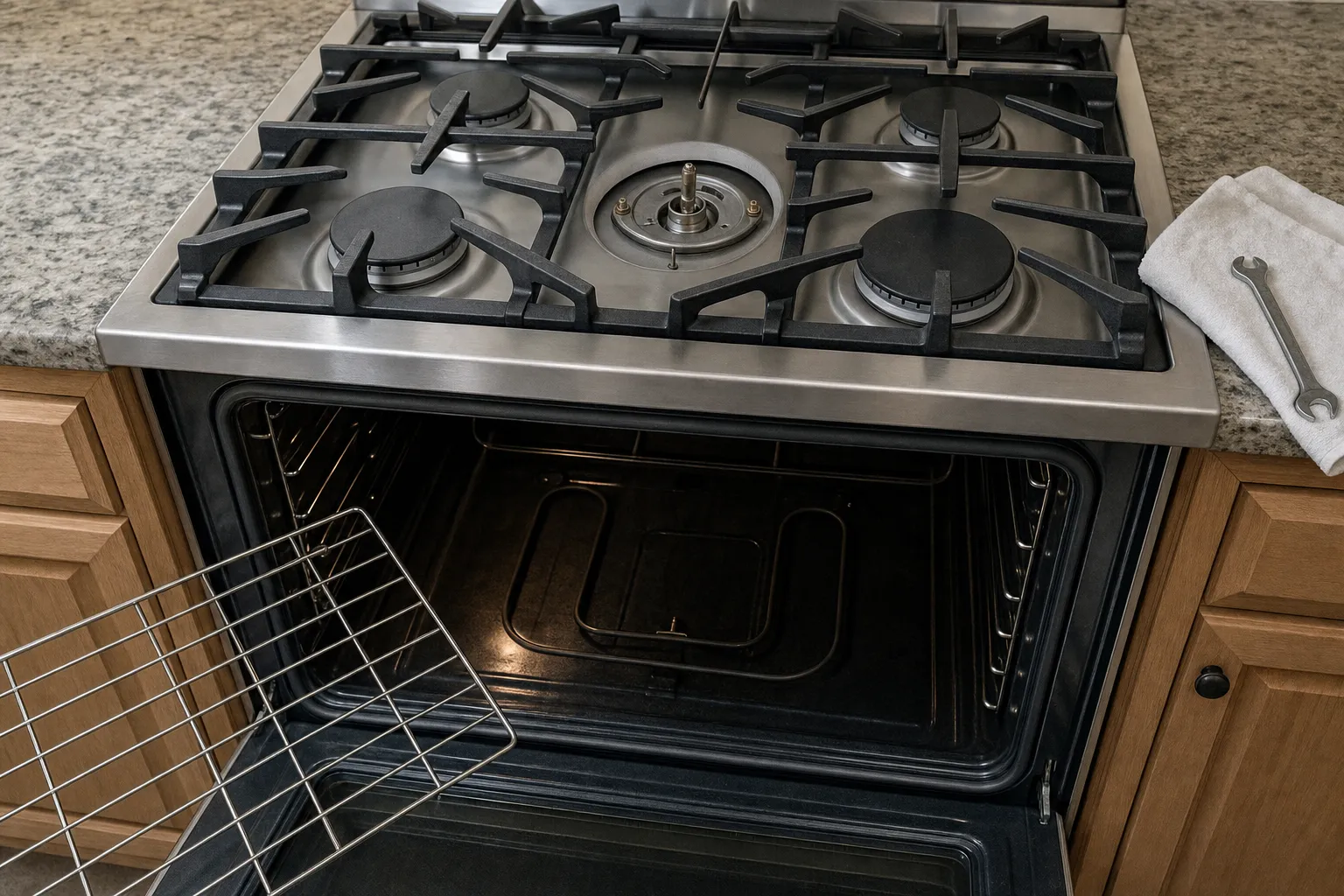
Issaquah fills its taps from two places. Much of the town drinks groundwater from the city’s own wells, while the Highlands and Talus receive surface water bought in from Cascade Water Alliance, a split this site’s Field Note on the two waters sets out. On a Viking cooktop the difference shows up after every boil-over. Water from the wells tends to leave a pale mineral crust as it dries; water from the Cascade side leaves mostly whatever was cooking. Both clog burners, they call for slightly different patience, and the wrong cleaning method does more harm than either.
What each water leaves behind
When a pot boils over, the water evaporates on the hot burner and whatever was dissolved in it stays put. On the well side of town that includes minerals picked up underground, and repeated spills build a chalky white layer on the burner head, around the ports and under the cap. It is hard, it shrugs off a quick wipe, and each spill narrows the ports a little further.
In the Highlands and Talus the water itself leaves far less behind, so the build-up is mostly starch, sugar, fat and burnt sauce. It softens in warm soapy water, but it is sticky, and it carries grease and soot into the ports and onto the white ceramic of the spark electrode.
Either layer changes the flame. Partly blocked ports give a ring of uneven flames, some short and some lifting, and a burner that catches slowly from one side. The burner head and its ports page covers when cleaning brings a head back and when the head itself is worn out.
Cleaning that keeps the burners working
Viking’s use and care manuals for its gas ranges give a short routine that suits both kinds of residue. Everything below is done with every control off and the burners cold.
- Catch spills early. Wipe up a boil-over once the cooktop has cooled and before it bakes on. Viking asks for the caps and heads to be cleaned after every spill-over, not only when they look dirty.
- Wash caps and heads by hand. Lift them off and wash them in warm soapy water with a soft cloth; for cooked-on food, a non-abrasive cleanser on a soft brush or a soft scouring pad. The manuals rule out the dishwasher and the self-cleaning oven for these parts.
- Clear ports with a pin. A straight pin pushed straight through, never a toothpick, and never anything that widens or bends the port.
- Keep water out of the base. Wipe the burner base with hot soapy water without letting it run into the large opening at the centre. Loosen crusted spills with a hot towel laid over them, then lift them with a wooden or nylon spatula, not a metal one.
- Leave the harsh stuff in the cupboard. No steel wool, abrasive powders or abrasive cloths on burner parts, and no ammonia or abrasives on the knobs, whose markings they can strip.
- Dry before reassembly. Every part goes back completely dry, and each cap should sit flat on its head.
Mineral crust from well water is the slow case. A longer soak in warm soapy water softens it, and patient work with the soft brush and a pin through each port removes it without damage. It takes longer than food film; that is not a reason to reach for anything harsher.
Brass burners, where a range has them, want the same gentle handling. A dull or darkened finish does not change how they burn, and the page on brass burners explains the kinds of wear that do.
Why steam and spray cleaners cause trouble
A steam cleaner looks like the answer to baked-on residue, and on a gas cooktop it tends to create the next fault instead. Steam drives water into exactly the places that must stay dry: the burner ports, the wells around the spark electrodes, the centre opening of each burner base, and the gaps around the knobs where the ignition switches sit. Viking’s manual for one of its current professional ranges asks owners not to let water drip into that centre opening even during an ordinary wipe; a jet of steam pushes in far more.
The result is usually a burner that ticks and will not light, or the whole cooktop ticking with every knob off, until the moisture works its way out hours or a day later. Spray cleaners aimed at the cooktop do the same on a smaller scale. Spray the cloth, not the range.
In the damp months that drying takes longer in an Issaquah kitchen, so a cooktop steamed on a wet evening can still be misbehaving at breakfast.
When cleaning stops being the answer
Cleaning restores a burner whose parts are sound. It does not mend a head that is cracked or warped, ports that were opened up with a drill bit or a nail, a cap corroded where it sits, or porcelain that has chipped and begun to rust beneath the burners. That last one spreads quietly in shaded and lakeside kitchens, because bare metal at a chip stays damp and the rust travels under the enamel. When several burners are affected, the choice between parts and a new cooktop is weighed under chipped porcelain and rust under the burners.
Viking Repair Issaquah looks at a burner that still misbehaves after a proper clean: the flame pattern, the cap seat, the state of the ports and the ignition. Call (425) 920-9484 and mention which water supply the house is on.
Asked about this
Can I put Viking burner caps in the dishwasher?
No. Viking's care instructions for its gas ranges say not to clean burner caps or heads in a dishwasher or a self-cleaning oven. Wash them by hand in warm soapy water with a soft cloth, dry them fully and seat them flat. If a cap will not sit level afterwards, call Viking Repair Issaquah on (425) 920-9484.
What should I use to clear a blocked burner port?
A straight pin, pushed gently straight through the port. Viking's manuals rule out toothpicks and warn against enlarging or bending the port, since a misshapen port spoils the flame. If ports keep closing up with white crust, the tap water is the likely source; Viking Repair Issaquah can check the burner on (425) 920-9484.
Is a steam cleaner safe to use on a Viking cooktop?
Keep it away from the burners. Steam forces water into the ports, the electrode wells and the gaps around the knobs, and a wet electrode or switch can tick without lighting until it dries. Wipe with a barely damp cloth instead. If the ticking carries on once everything is dry, call Viking Repair Issaquah on (425) 920-9484.