Viking Oven Repair
Is It Normal for a Viking Oven to Smell After Cleaning?
Yes, a mild smoky or chemical smell after cleaning an oven is normal and should fade within one or two ordinary bakes. A gas odor that lingers, a hot-plastic smell, or an odor that grows with each use is not, and needs a check.
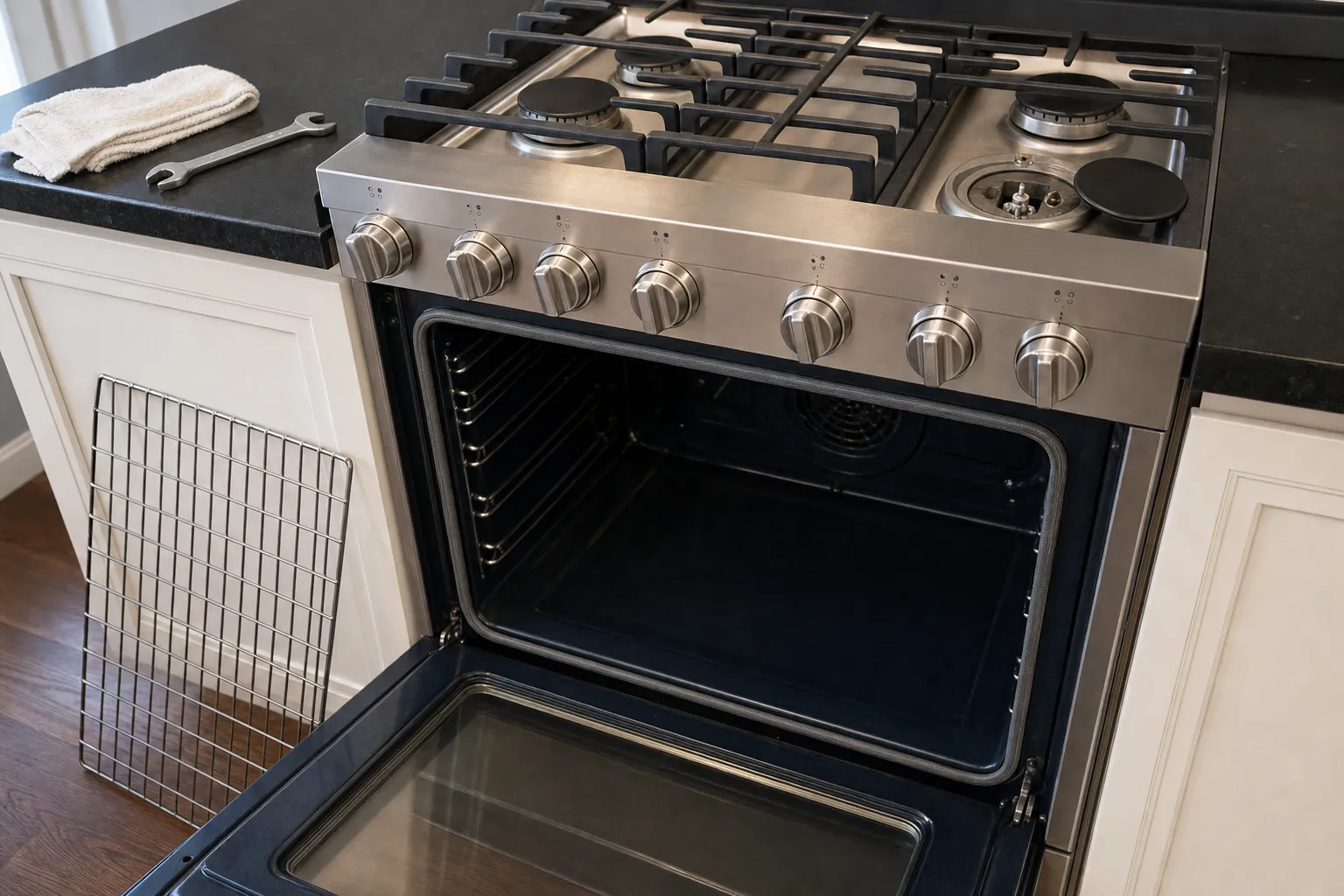
Yes. An oven that smells for a day or two after a cleaning is normal, whether you ran self-clean or scrubbed the cavity by hand. During self-clean a Viking oven climbs as high as 750°F so that baked-on grease turns into pale ash, and that burn-off leaves a sharp, smoky odor until the next couple of bakes carry it away. What is not normal is a gas smell that does not clear, a hot-plastic or electrical smell, or an odor that returns every time the oven runs. In Issaquah, where the long wet season keeps windows closed for months, a cleaning smell can hang around longer simply because the kitchen is shut up, so it pays to know which kind you have.
What a self-clean cycle actually burns off
The self-clean setting is anything but gentle. The oven locks its door, heats far past any cooking temperature and holds there until sugar, fat and food residue are reduced to dust. Viking puts the cycle at roughly 3 to 3½ hours depending on the model, followed by an extra half hour of cooling before the door will open. On the 3 Series RVGR3302 gas range the complete cycle is shorter, about 2-1/2 hours, again with about 30 more minutes before the latch lets go.
Most of the odor comes from three places:
- The soil itself. A thick crust from roasts or a pie that bubbled over makes far more smoke than a thin film.
- Anything left inside. Chrome racks, a forgotten pan or a pizza stone can discolor, smoke or crack at that heat. Remove whatever your manual does not list as safe for the cycle.
- A first cycle on a newer oven. Insulation and coatings around the cavity can release a faint odor the first time they reach self-clean heat, and that fades afterwards.
A smoky, slightly acrid smell during the cycle, then a weaker version over the next one or two bakes, fits all three.
Chemical smells after a hand scrub
Hand cleaning leaves a different odor: chemical rather than smoky. Oven cleaner that was not rinsed off completely bakes onto the walls the next time the oven heats, and it smells harsh, sometimes close to ammonia. Let the oven cool, then wipe every surface again with plain warm water, especially the edges of the door glass, the corners of the floor and the spots behind the rack supports where foam pools.
Keep cleaner away from the woven seal around the door, too; a soaked or stiffened seal lets heat and odor leak out around the frame. If yours is frayed, flattened or gapped after a cleaning, look at a replacement Viking range door gasket.
The rangetop can be the culprit as well. Viking suggests soaking burner grates 15-20 minutes in hot soapy water, drying them fully, then giving the undersides a light coat of cooking spray and blotting it dry. Skip the blotting and that oil smokes the first time the burners run, which is easy to mistake for an oven problem.
Clearing the smell, and reading what it tells you
Run the hood on high during the cycle and for a while after, and open a window even briefly. Move pet birds to a distant room before starting, since their lungs react to fumes people barely notice. Once the cavity is cool, wipe the ash out with a damp cloth, then heat the empty oven at an ordinary baking temperature until the odor stops.
If the smoke becomes too much and you cancel a cycle, be patient with the door. On a 7 Series dual fuel range, cancelling during the first 30 seconds, before the latch has fully engaged, can leave the door locked. Viking’s fix is to turn both knobs to SELF-CLEAN until the bezel light pulses yellow, then turn both to OFF; the door releases when the solid yellow light disappears.
| What you smell | Likely source | What to do |
|---|---|---|
| Smoky, ashy | Soil burned off during self-clean | Wipe out the ash, ventilate, run one empty bake |
| Sharp chemical | Oven cleaner left on the walls | Wipe again with clean water, then heat empty |
| Hot oil from the top | Grate spray not blotted | Let it burn off with the hood on high |
| Gas, like rotten eggs | Burner, valve or igniter | Turn it off, air the room, call |
| Hot plastic or wiring | A damaged part or wire | Stop using the oven until it is checked |
When the smell is gas, not cleaning
Natural gas and propane carry an added odorant that smells like rotten eggs, so your nose is the first alarm. A trace of it for a moment as the bake burner lights is common, since a small amount of gas reaches the burner just before the flame catches. On a 5 Series gas range, SureSpark ignition fires the Gourmet-Glo infrared broiler as well as the U-shaped bake burner rated at 30,000 BTU, so you may hear clicking and notice a faint smell right at light-off.
Ovens with a hot-surface igniter keep the gas valve shut until the igniter is hot enough to open it. A glow-bar igniter weakened by age can be slow to do that, which shows up as a long wait, a soft whoomp when it finally lights, or an oven that never reaches temperature.
A gas odor that persists once the flame is burning, any gas smell with the oven switched off, or a smell that builds during a bake is not normal. Turn the knob off, avoid light switches or anything that could spark, step outside and phone the gas utility’s emergency line from there. Cleaning can trigger this indirectly: a burner part nudged out of place or ports clogged with cleaner can produce a lazy, yellow, smelly flame.
Foil, fumes and carbon monoxide
Lining the floor of a gas oven with foil to catch drips seems harmless, but the CPSC warns that it blocks the combustion air moving through a natural gas or propane oven and can produce carbon monoxide. CO has no smell at all, so a headache or a stuffy feeling in the kitchen while baking matters more than any odor. A working CO alarm near the kitchen and the bedrooms is the backstop.
When to have it looked at
Call (425) 920-9484 if a smell outlasts the second or third normal bake, if the oven has heated unevenly since a cleaning, if the door seal looks damaged, or if the cycle ended early. Self-clean heat is hard on parts already near the end of their life, and a thermostat, element or igniter sometimes quits during or right after the cycle. We work in homes across Issaquah Highlands, Olde Town Issaquah, Talus and Klahanie. Our $89 visit covers the diagnosis, and that charge is deducted from the repair if you go ahead. As typical ranges, an oven thermostat or heating element runs $190–$470 and an igniter or burner assembly $180–$440, with the firm price set after diagnosis. More on the work itself is on our Viking oven repair page.
Asked about this
Is it normal to smell gas when a gas oven preheats?
A faint whiff for a few seconds as the bake burner lights can happen, since a little gas arrives just ahead of the flame. A smell that lasts past the first minute, returns with the oven off or keeps building is not normal: shut it off, air the room and call Viking Repair Issaquah at (425) 920-9484.
How long should the smell last after a self-clean cycle?
Usually through the next one or two bakes. Many Viking ovens run the cycle 3 to 3½ hours plus about 30 minutes of cooling, and much of the odor leaves during that time if the kitchen is aired. If it persists after a third bake, Viking Repair Issaquah can check the oven: (425) 920-9484.
Can I line the bottom of my gas oven with foil so I clean it less often?
No. The Consumer Product Safety Commission warns that foil over the floor of a natural gas or propane oven blocks combustion air and can lead to carbon monoxide. Set a sheet pan on a lower rack instead. If foil has already fused to the oven floor, call Viking Repair Issaquah at (425) 920-9484.
What does a visit cost if the smell turns out to be a fault?
The visit is $89 with the diagnosis included, and those $89 come off the repair once you approve it. Repair prices depend on what failed, so Viking Repair Issaquah gives a firm quote only after finding the fault. Call (425) 920-9484 to arrange a visit.