12/44 Burners
Viking Orifice Spuds: Natural Gas and LP
The small brass fitting at the foot of each burner that decides how much gas it gets.
- Written by
- Hollis Yamada
- Works on
- Service technician — refrigeration and cooking
- Experience
- 21 years in the trade
- Published
What the spud does
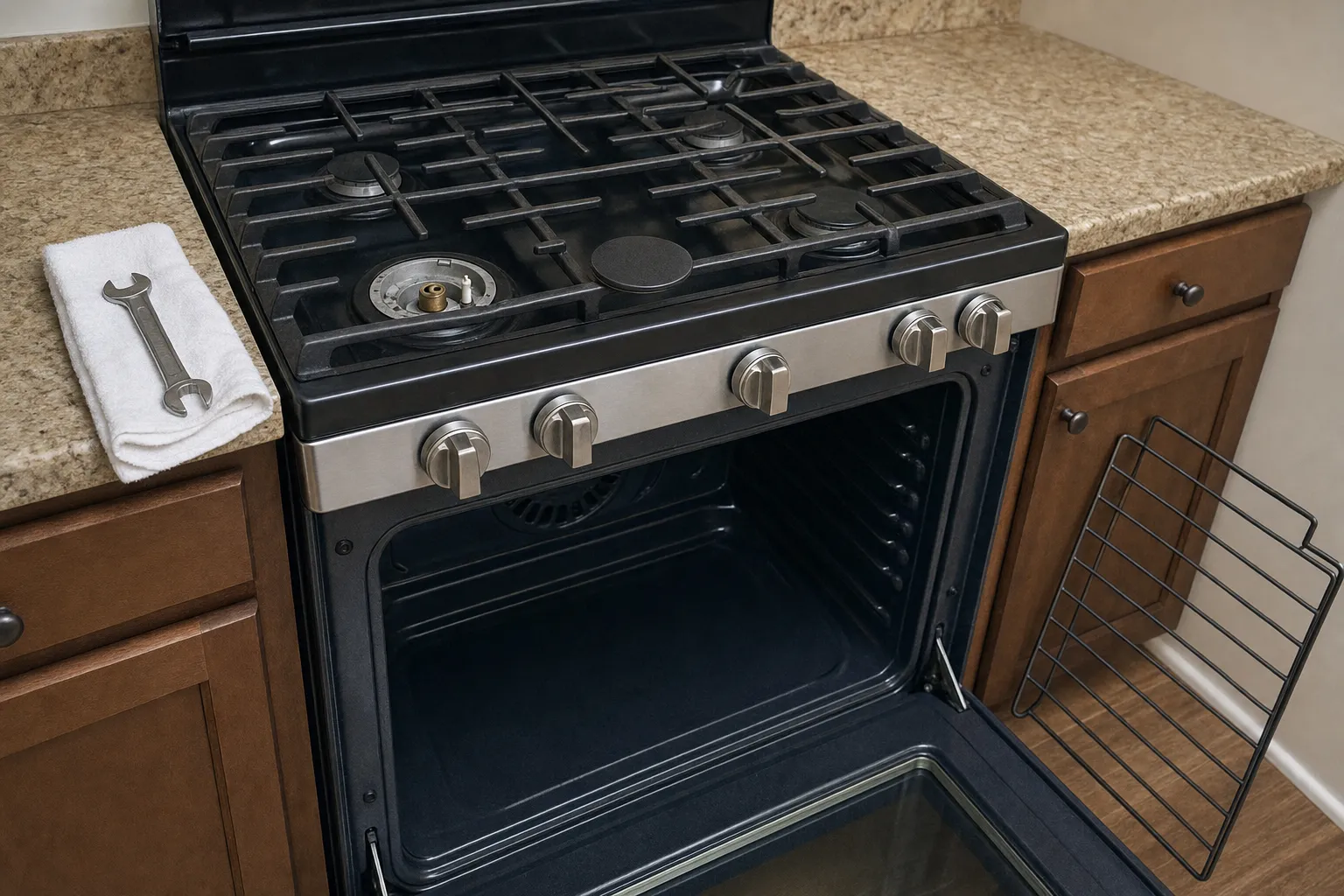
The orifice spud, the small brass fitting at the foot of each burner, decides how much gas that burner receives. Viking’s service manual for its freestanding gas self-clean ranges shows an orifice hood on each surface burner: adjusted on natural gas, screwed down onto a fixed orifice for LP. Other generations differ; the LP conversion kit covers what else changes with the fuel.
How it fails here
Inside town most Issaquah homes sit on the gas main; out toward the hills, houses run on propane. Trouble starts when a range meets a fuel it was not set for, usually after a second-hand purchase or a move. Whether to adapt an older range or buy one built for LP is weighed in convert to propane or buy an LP range. Checking an orifice is part of range repair.
Signs and thresholds
| What you notice | The line it crosses | What happens next |
|---|---|---|
| Tall yellow flames and soot on pans after a move or a fuel change | Any time the gas supply may have changed | Stop cooking on it; the orifice setting is checked against the supply. |
| Small, weak flames on every burner that die at low | All burners at once, not just one | Suspect orifices set for the other gas; a technician confirms. |
| One burner weak while the rest are normal | Still weak with a clean head and a flat cap | A partly blocked orifice or a disturbed setting on that burner. |
| Gas smell near a burner with the knob off | Any smell at all | Leave the house, call the gas utility or 911 from outside, then the business. |
What you can do yourself
- Find out which gas the house runs on: a utility meter outside, or a propane tank on the lot.
- If the rating label is visible without moving the range, note which gas it names.
- Leave burners, orifices and everything below the cooktop alone.
- Stop there. Anything past this is a job for Viking Repair Issaquah — call (425) 920-9484.
When to call
Ring when flames are yellow and sooting, weak on every burner, or wrong since a move or a fuel change; with any gas smell, get out first.
Call (425) 920-9484Asked about the orifice spud
Does a Viking range need different orifices for propane?
Yes. Propane arrives at higher pressure and carries more heat than natural gas, so each burner needs a smaller opening. In Viking's service manual for its freestanding self-clean ranges, the orifice hood is screwed down onto a fixed orifice for LP. Viking Repair Issaquah can check yours; call (425) 920-9484.
Can I drill the orifice out to get a bigger flame?
No. An orifice is sized for its burner and fuel; drilling it passes more gas than the burner can mix with air, giving a yellow, sooting flame and a carbon monoxide risk. Viking Repair Issaquah can trace why a burner runs weak instead; call (425) 920-9484.
We moved our Viking range to a house on propane. Can we light it?
Not until its setup matches the new fuel; orifices and other settings are made for one gas. Whether to adapt it or buy an LP model is a separate decision. Viking Repair Issaquah can inspect it and explain what it is set for; call (425) 920-9484.